From a team at EBP1 comes an interesting deep(ish) dive into a “talk to the map” solution – that is, a chatbot in a map interface. The article (in German, but in-browser translation ought to work well) explains a GenAI2 R&D project conducted by Maria Matache, Luca Zaczkowsky, and Adrian Meister that developed such a solution.
In the process, they set out to address three specific goals (quotes stem from the article):
Measurable performance and optimisation: “understand where time and tokens3 are being used, and make the system measurably faster and more cost-effective”
Configurable data assets: “integrate new data sets as configurations rather than as code”
Ease of re-use: “reuse the same solution for other use cases or a second site without having to rebuild everything from scratch”
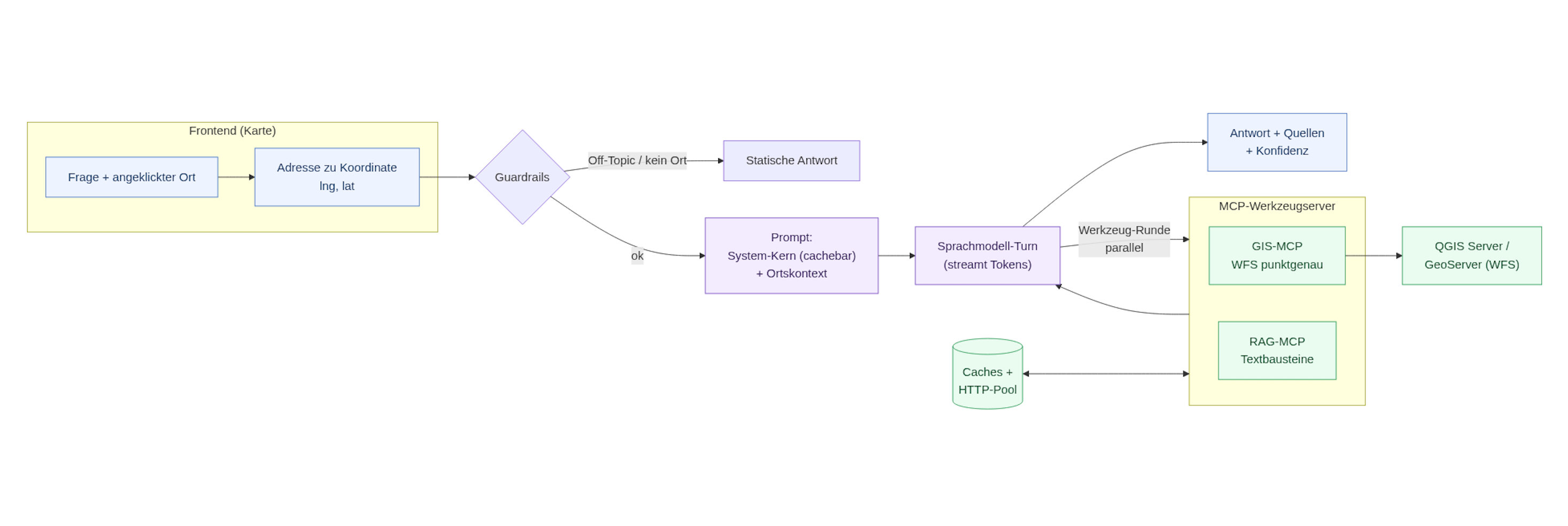
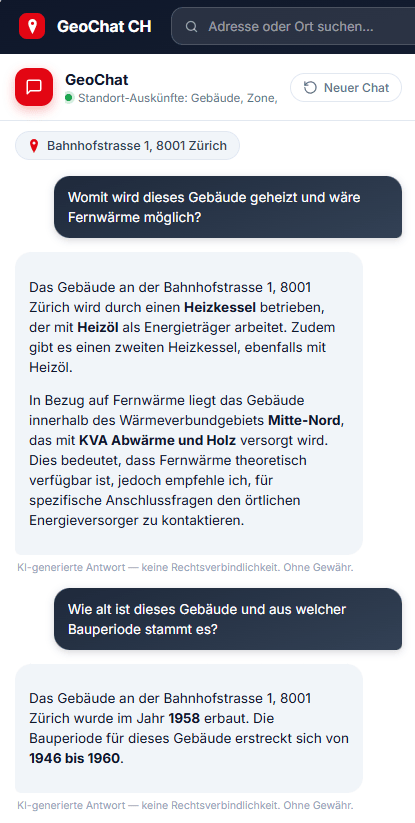
In addition to the goals above, the article briefly explains guardrails to catch off-topic interactions and problematic content, to prohibit mass querying, and to cap maximum possible operation costs. Two examples show the behaviour of the working solution in the contexts of the city of Schaffhausen and the canton of Zurich.
Footnotes
Transparency note: I work at EBP. I was not involved in the project at hand, however.↩︎
“Generative AI”, that is artificial intelligence systems that generate new media (text, code, images, audio, video) rather than only analysing or classifying existing data.↩︎
The units of text (words or word fragments) that language models process; usage and cost of LLM-based systems are typically measured in tokens.↩︎