I only got around to it now, but already back in April, the Cloud-Native Geospatial Forum1 published an interesting article on data quality titled “Beyond open data: Usefulness is a better measure of quality than openness”.
The article starts with an assessment of the state of open data:
We are currently in an era of exponential data growth and unprecedented accessibility, driven by rapid technological advancements and the rise of automated agents capable of consuming data at scale. While historical efforts to champion “open data” established admirable goals, the colloquial concept has become lackluster and antiquated. Making data broadly accessible, in theory, does not inherently make it useful in practice.
I wouldn’t quite agree: I think opening data in an era of partial(!) abundance of data is still an important concern. But I do agree that the open data movement has lost some of its momentum, partly because much has been achieved. I also agree that focussing exclusively on openness of data is ill-advised: It would overshadow other important dimensions of data usability. That latter point is what the authors of the article are getting at: They propose a more holistic approach to data quality, which includes not only openness but also other dimensions:
We need a better way to represent the ultimate goal of open data: moving beyond a basic baseline of “openness” to evaluate data on a future-looking spectrum of usefulness. (…) Our goal was to shift the evaluation from simply asking “how open is this?” to “how easily can this be used and reused for a specific purpose, or by a general audience with diverse needs?”
Going beyond traditional data classification schemas like the 5 Star Open Data2 scale or the FAIR principles3, the authors propose a more nuanced framework for assessing data quality, which includes these dimensions:
- License: What does the license allow? Is it standardised and clear?
- Cost: Direct and indirect costs
- Burden (includes interoperability): How long does it take a reasonably skilled user to access and start using the data?
- Accessibility: Degree to which the data can be accessed and used by a wide range of users; includes e.g. cumbersome formats, lack of APIs4
- Provenance: How well is the lineage of the data known? Does it have documentation? Does it have metadata?
Besides these, the authors also considered interoperability, intent, data domain coverage and granularity, data structure, integration points (APIs), documentation and user support, compliance and schema completeness (some of which they have now subsumed into the above dimensions).
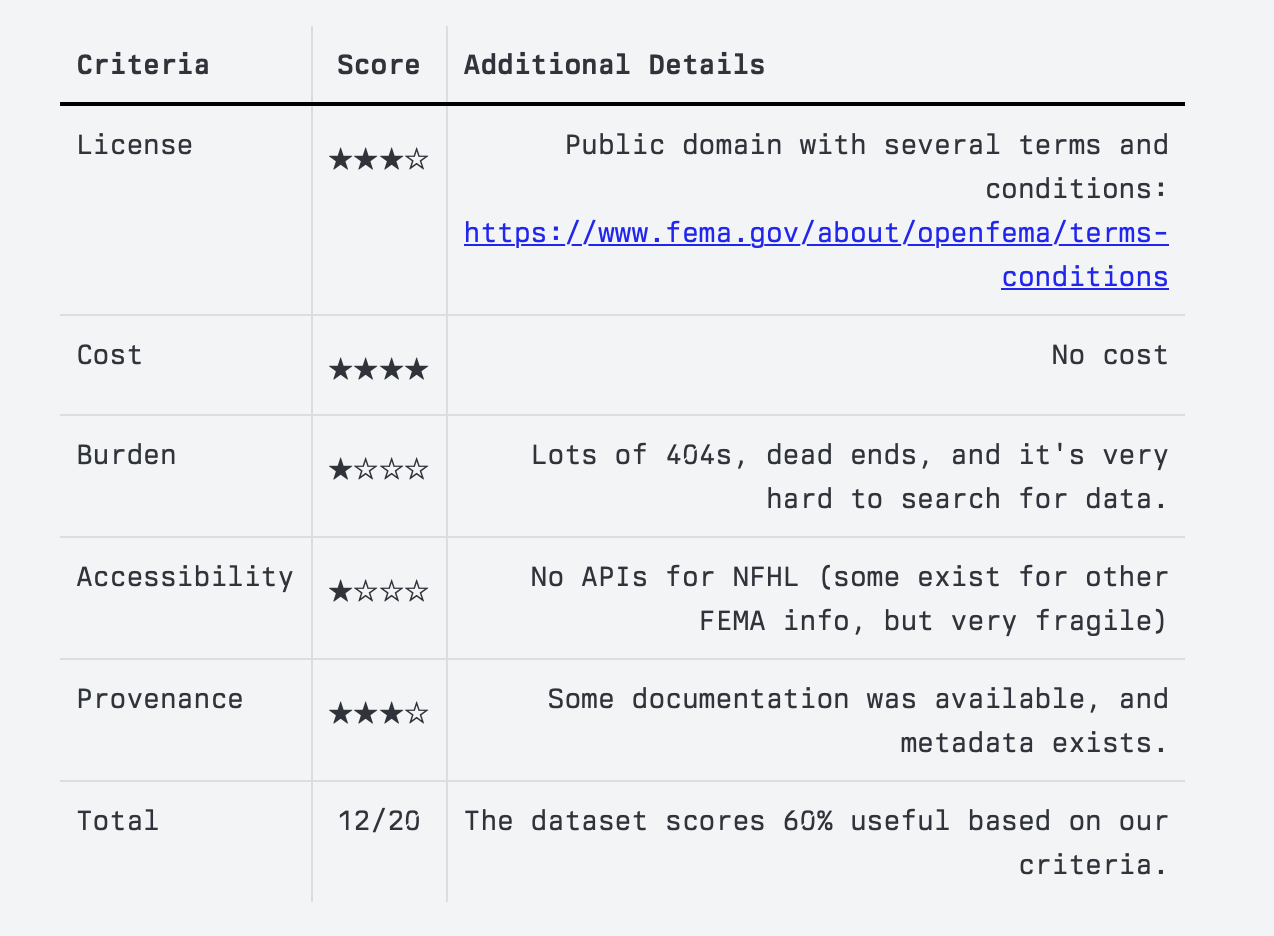
The authors propose a classification schema to award a dataset 1 to 4 stars for each of the above dimensions. This star rating is detailled in the article. I would argue all these measures could fit within established data quality standards such as ISO 19157:2013 with its “usability” dimension and ISO 19157:2023 with its mechanism for adding additional data quality components.
The CNG article also links to white paper (pdf) that goes into more detail on the proposed framework and the rationale behind it. Well worth studying, in my opinion.
Footnotes
CNG.↩︎
The 5-star Open Data deployment scheme proposed by Tim Berners-Lee rates datasets from 1 star (available online under an open license, any format) to 5 stars (linked open data with URIs and links to other data sources).↩︎
The FAIR principles (Findable, Accessible, Interoperable, Reusable) are guidelines for scientific data management and stewardship, aimed at making data more usable by both humans and machines.↩︎
Application Programming Interfaces.↩︎
The Federal Emergency Management Agency (FEMA) is a government agency in the USA responsible for coordinating disaster preparedness, response, and recovery.↩︎