I have a soft spot for (spatial and conceptual) vagueness in geography. Thus, a recent article about incorporating spatial vagueness (or fuzziness) into PostGIS through ”fuzzy spatial algebra” piqued my interest. The article by Jesper Fjellin lays out a concept for fuzzy geometries as first-class data types in PostgreSQL:
A known limitation in the geospatial world is that the vector data types we normally use, like point, linestring, polygon, and their multi-variants, are crisp. They work in a binary way: for a polygon, a location is either inside it or outside it.
This works well for neatly defined data sets like buildings, roads, and administrative borders, but it becomes awkward when the thing you are trying to model does not really have a hard edge. Traditional geometry types are very good at answering spatial relationship questions like “does this intersect?” or “is this contained?”, but they do not let the geometry itself express that some locations belong more strongly than others.
Many spatial phenomena are vague. Science has come up with, and applies, fuzzy set theory to model such phenomena. The article concisely describes the idea:
Mathematically, the idea is not too complicated. A crisp region behaves like a yes/no function: χ_R(x) ∈ {0,1}. A fuzzy region behaves like a membership function: μ_R(x) ∈ [0,1]. So instead of only asking whether a location is inside or outside, we can ask to what degree it belongs to the region.
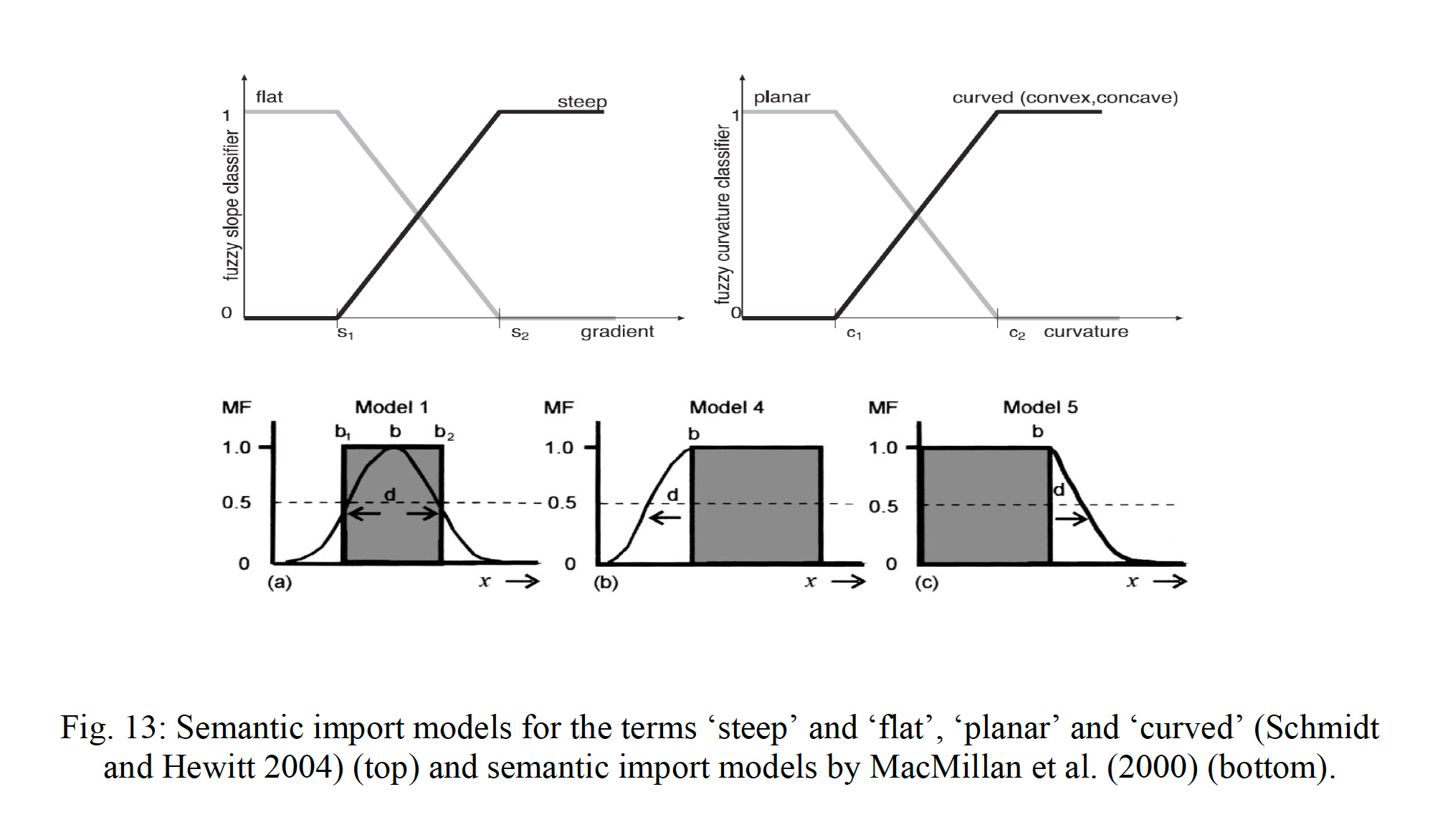
What doesn’t become quite clear to me from reading the article is: Are the fuzzy geometries implemented in a gradual, non-discrete way (that is, PostGIS would implicitly and following some yet-to-be-defined rule interpolate between the crisply defined extents of different alpha levels)? Or are they defined in a discrete-but-stepped way (no interpolation would occur)?
The former would be way more powerful and approximate vagueness well, the latter only partly. The question points to something else: Historically, the application of fuzzy set theory to spatial phenomena has very much been the purview of the field data model1 and thus the raster data type, not vector.
But maybe it doesn’t have to be that way?
Footnotes
Think, for example, a digital elevation model or a rainfall intensity raster.↩︎