Stefan Ziegler’s efforts to geo-enable Apache Hop1 (previously) continues: After vector data support through OGR2 reader and writer plug-ins, a geometry inspector, some INTERLIS3 integration, and more, Stefan is now tackling raster data. In Let’s Hop 6: Pixel für Pixel (alternatively: on LinkedIn), he describes4 how he added several raster transforms to his hop-gdal-plugin using the newer GDAL tool structure.5
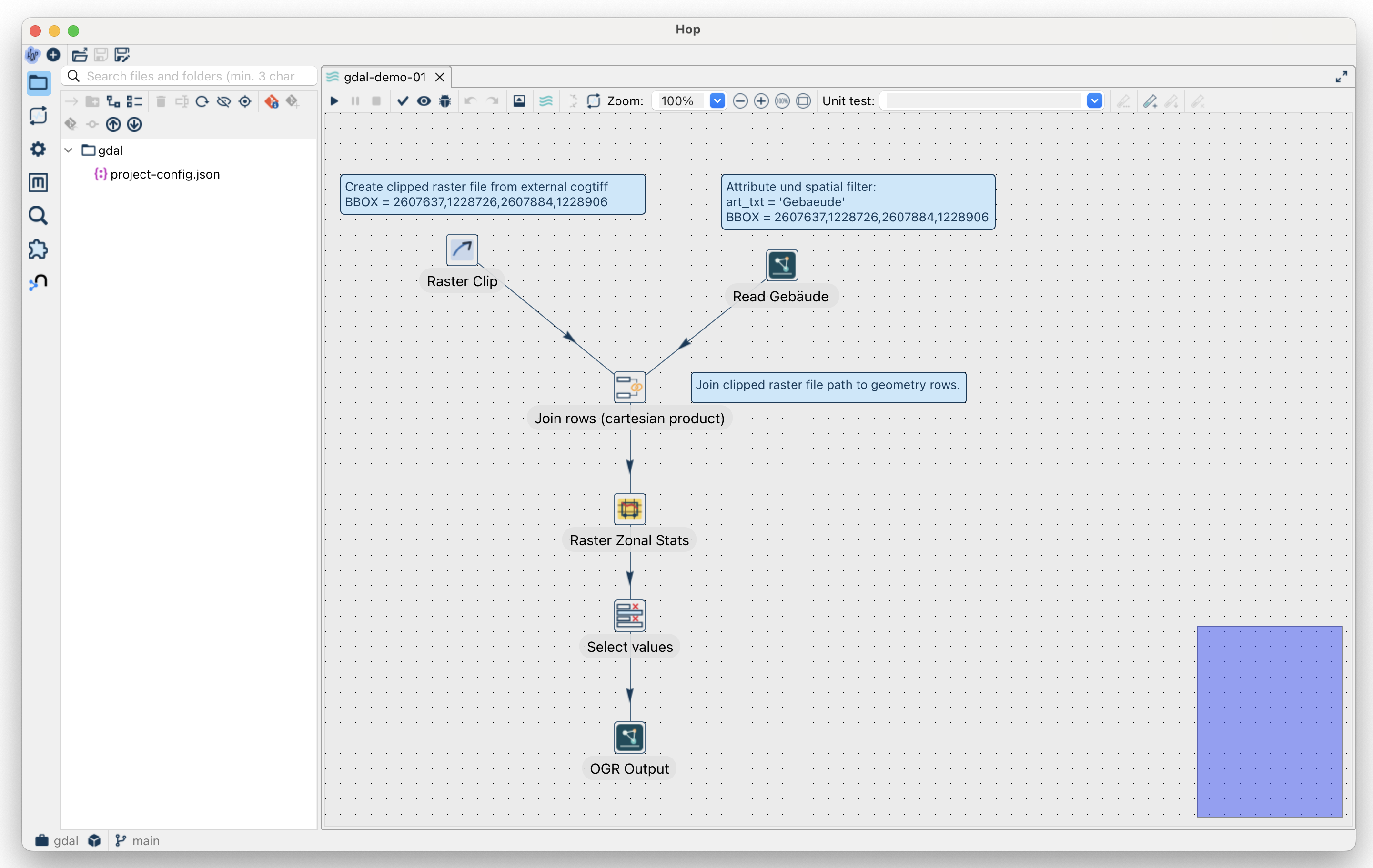
To demonstrate the new capabilities, Stefan walks through a pipeline that computes building heights from LiDAR6 and vector data: an OGR reader ingests building footprints from a GeoPackage7 file, while a Raster Clip transform clips the corresponding extent from an externally hosted COG8 file. The two streams are joined9, and a Raster Zonal Stats transform10 is used to calculate average and maximum height per building. The result is written back to GeoPackage via an OGR output.
Nice to see the geospatial capabilities of Hop further expanded. To recap Stefan’s series11:
- Let’s Hop 1: Laying the Foundation12
- Let’s Hop 2: Die Idee ist gut, die Vorschau ist besser
- Let’s Hop 3: A native ili2db Integration for Apache Hop
- Let’s Hop 4: Ich möchte Teil einer Validierung sein
- Let’s Hop 5: Geometrien bearbeiten, Layer vergleichen, Coverages prüfen
- Let’s Hop 6: Pixel für Pixel
Stefan’s “INTERLIS made easy” series is at 61 instalments. Let’s see how far “Let’s Hop” will go.13
Footnotes
If you need a reminder: Apache Hop is an open-source ETL (extract-transform-load) solution that – in its own words and certainly in the hopes of some stakeholders – “aims to be the future of data integration.”↩︎
OGR is the vector data library within GDAL supporting a wide range of vector formats.↩︎
INTERLIS is a Swiss standard for geodata modelling and data exchange.↩︎
in German↩︎
Think, for example,
gdal raster hillshadeinstead of the very broadgdal_translateorgdalwarp.↩︎Light Detection and Ranging, an active remote sensing technique that uses laser pulses to generate 3D point clouds of the Earth’s surface or objects.↩︎
An open SQLite-based container format for geospatial data, defined by the OGC.↩︎
Cloud-optimized GeoTIFF.↩︎
Here, Hop feels somewhat unwieldy, I would say.↩︎
Here, Stefan finds the user interface somewhat overwhelming.↩︎
The articles are all on LinkedIn, as well, but here I use the more sovereign links to Stefan’s blog.↩︎
While some articles have English titles, they are all written in German.↩︎
🤞– which, of course, is not a sustainable strategy.↩︎